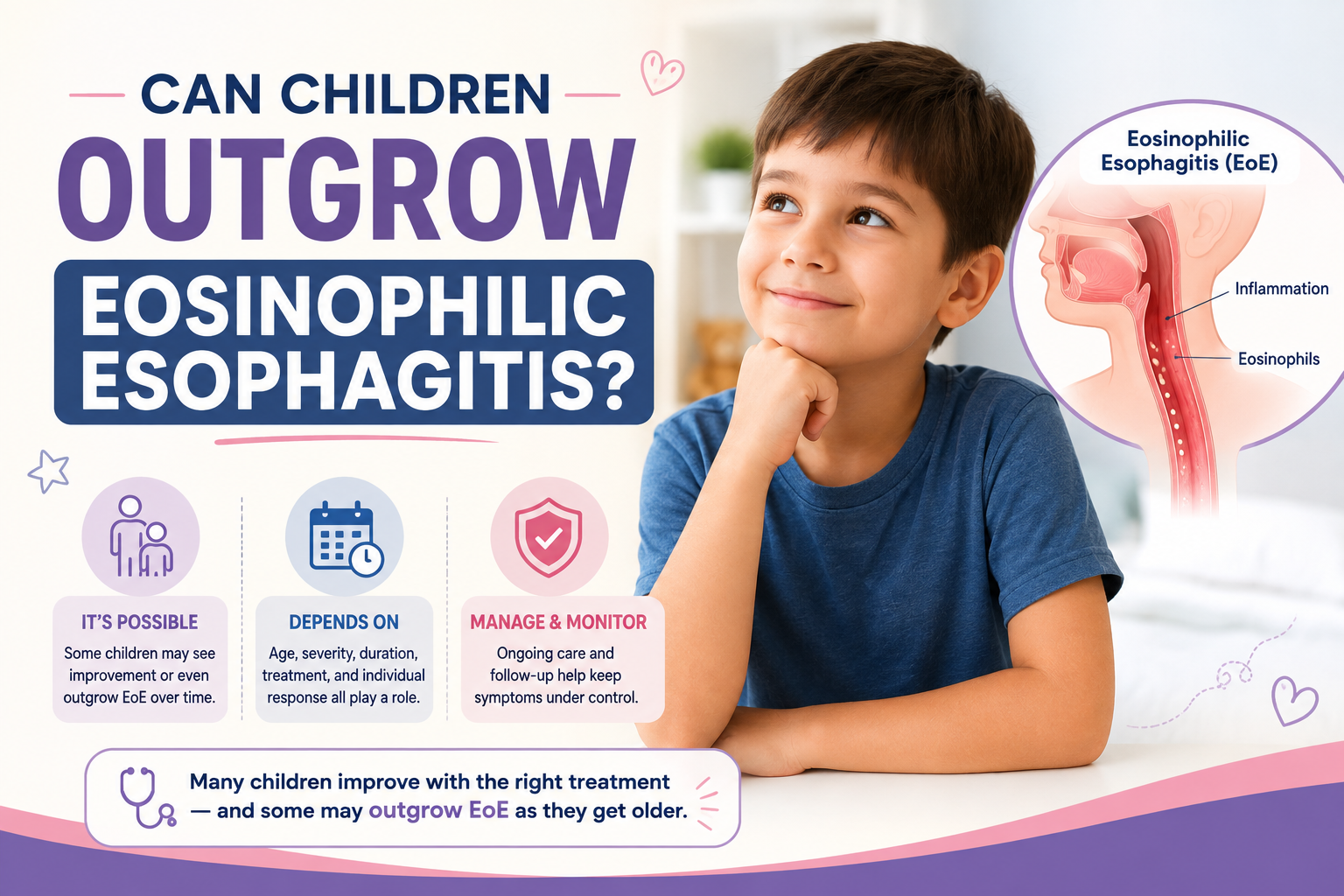
Parents asking whether can children outgrow eosinophilic esophagitis usually want to know whether years of restricted diets, medication, endoscopies, and stressful meals will eventually end. The most accurate answer in 2026 is that most children do not fully outgrow eosinophilic esophagitis, or EoE. It is generally treated as a chronic immune-mediated disease that can become well controlled but may return when treatment is stopped.
A child may have long stretches without obvious symptoms, and some may reach clinical and tissue remission. That is encouraging, but remission is not always the same as a permanent cure. Because inflammation can remain active even when eating seems easier, decisions about stopping treatment should be based on a pediatric gastroenterologist’s evaluation, usually including endoscopy and biopsies.
| Medical review note: This article is educational and does not replace care from a pediatric gastroenterologist, allergist, or registered dietitian experienced in EoE. |
Key Takeaways
- Most children do not permanently outgrow EoE, although the disease can enter remission with effective treatment.
- Feeling better does not prove the esophagus has healed because symptoms and tissue inflammation do not always match.
- Stopping medication or adding foods back without a structured plan can allow inflammation to return.
- Long-term control may involve proton pump inhibitors, swallowed topical steroids, food elimination, biologic therapy, or a combination approach.
- Repeat endoscopy with biopsies remains important for confirming whether treatment is controlling inflammation.
- Food stuck in the esophagus, inability to swallow saliva, chest pain, or breathing difficulty requires urgent medical attention.
Can a Child Truly Outgrow EoE?
For most families, the practical answer is no. EoE is considered a chronic allergic and immune condition. Pediatric specialists may use the word remission when symptoms improve and biopsies show that eosinophilic inflammation has fallen below the treatment target. Remission can last for months or years, but it does not guarantee that the disease will never return.
A small minority of children may appear to have prolonged remission without active treatment, but current experts do not consider spontaneous permanent resolution predictable. There is no reliable test that can identify which child, if any, will stay well after treatment is withdrawn. For that reason, most treatment plans focus on long-term control rather than waiting for a child to outgrow the condition.
What Is Eosinophilic Esophagitis?
EoE is an inflammatory disease of the esophagus, the tube that moves food from the mouth to the stomach. In children with EoE, eosinophils, a type of white blood cell involved in allergic inflammation, build up in the esophageal lining. The inflammation can cause swelling, pain, feeding problems, swallowing difficulty, and eventually scar tissue or narrowing.
Food proteins are common triggers, particularly milk, wheat, egg, and soy, but the exact trigger varies from child to child. Many children also have asthma, eczema, environmental allergies, or immediate-type food allergies. EoE is not the same as a typical food allergy, and routine skin or blood allergy tests cannot reliably identify which food is causing the esophageal inflammation.
Why Does EoE Usually Continue Into Adulthood?
EoE is driven by an ongoing immune response rather than a temporary infection. When a trigger remains present, or when anti-inflammatory treatment is removed, eosinophils can return to the esophageal tissue. Over time, repeated inflammation can lead to remodeling, stiffness, rings, narrowing, and strictures.
The disease may look different as a child grows. A toddler who vomits or refuses food may later become a school-age child with abdominal pain, and then a teenager who eats slowly or avoids bread and meat. A change in symptoms can create the impression that the disease has disappeared even though the child has simply developed new eating habits or learned to avoid foods that are hard to swallow.
How Can EoE Symptoms Change as a Child Gets Older?
| Age group | Common signs | What parents may notice |
| Infants and toddlers | Vomiting, reflux-like behavior, feeding refusal, arching, poor weight gain | Long feeding times, distress with bottles or solids, preference for liquids |
| School-age children | Abdominal pain, nausea, vomiting, heartburn, slow eating | Avoiding certain textures, taking tiny bites, drinking frequently with meals |
| Teens | Difficulty swallowing, chest discomfort, food sticking, food impaction | Avoiding meat or bread, chewing excessively, eating last, hiding swallowing problems |
Important: Children often compensate without realizing it. Eating slowly, cutting food into very small pieces, drinking after every bite, or avoiding dense foods can mask worsening narrowing.
What Is the Difference Between Remission and Outgrowing EoE?
| Term | What it generally means in EoE care |
| Symptom improvement | The child feels or eats better, but inflammation may still be present. |
| Clinical remission | Symptoms are minimal or absent. |
| Histologic remission | Biopsies show eosinophils have fallen below the treatment target. |
| Endoscopic improvement | Visible swelling, furrows, plaques, rings, or narrowing have improved. |
| Permanent cure or outgrowing EoE | The disease does not return without treatment. This is not the expected course for most children. |
Why Can a Child Feel Better While Inflammation Continues?
Symptoms are an imperfect measure of EoE activity. Children can adapt their eating behavior, and inflammation can remain active without causing dramatic pain. Acid-reducing medicine may improve heartburn even if eosinophilic inflammation is not fully controlled. A child may also be avoiding a trigger accidentally, such as drinking less milk, and then relapse when the food returns.
Current guidelines therefore recommend evaluating treatment response with symptoms, endoscopic appearance, and biopsy findings rather than symptoms alone. This is one reason families should not stop therapy simply because the child says swallowing feels normal.
How Do Doctors Confirm That EoE Is Controlled?
EoE is diagnosed and monitored through upper endoscopy with biopsies. During the procedure, a pediatric gastroenterologist examines the esophagus and collects small tissue samples. The samples are reviewed under a microscope for eosinophils and other signs of inflammation.
- Symptoms and feeding behavior
- Growth, weight, and nutritional status
- Endoscopic findings such as swelling, furrows, rings, white plaques, or narrowing
- The eosinophil count and other microscopic tissue changes
- Medication use and possible side effects
- Dietary adherence and the burden of food restrictions
The timing of repeat endoscopy varies. It may be performed after starting or changing treatment, after food elimination or reintroduction, or during longer-term monitoring. The child’s specialist should determine the schedule based on disease severity, treatment choice, and previous findings.
Which Treatments Can Keep Pediatric EoE in Remission?
The goal is not only to reduce symptoms. Treatment also aims to heal inflammation, preserve normal swallowing, support growth, and prevent scarring. Families usually choose among dietary therapy, medication, or both through shared decision-making with the care team.
Can Proton Pump Inhibitors Help?
Proton pump inhibitors, often called PPIs, can reduce eosinophilic inflammation in some children. They may be used as an initial treatment, even when classic acid reflux is not the main problem. A response must be checked with follow-up assessment because symptom relief alone is not enough.
How Do Swallowed Topical Steroids Work?
Budesonide or fluticasone can be swallowed so the medicine coats the esophagus. These are topical anti-inflammatory treatments, not the same as using a rescue inhaler for asthma. The prescribing team may monitor for oral yeast infection, adrenal effects, growth, and other potential concerns. In the United States, budesonide oral suspension marketed as Eohilia is FDA-approved for a 12-week course in patients age 11 and older.
Can an Elimination Diet Control EoE?
Food elimination can induce remission when trigger foods are removed. Current practice often starts with a less restrictive approach, such as removing milk alone, rather than immediately eliminating many food groups. A 2025 pediatric randomized trial found similar histologic remission rates for one-food and four-food elimination, while the broader diet was harder for families to continue.
Diet therapy should be supervised by an EoE-experienced clinician and registered dietitian. Removing major foods without nutritional planning can affect calories, protein, calcium, vitamin D, and growth. Foods are usually reintroduced in a structured sequence, with repeat endoscopy and biopsies used to identify triggers.
When Is Dupilumab Considered?
Dupilumab is a biologic medicine that targets key allergic inflammatory pathways. In the United States, it is approved for EoE in adults and children age 1 year and older who weigh at least 15 kilograms. It may be considered for children with more severe disease, multiple allergic conditions, inadequate response to other options, or treatment preferences that favor a biologic.
What Do Dilation and Feeding Therapy Do?
Esophageal dilation can widen a narrowed area and improve swallowing, but it does not treat the underlying inflammation. Anti-inflammatory treatment is still needed. Feeding therapy may help younger children with food aversion, limited textures, anxiety around meals, or oral-motor challenges that persist after inflammation improves.
What Usually Happens If Treatment Is Stopped?
EoE commonly becomes active again after effective medication or diet therapy is withdrawn. The timing varies. Some children relapse quickly, while others remain well for a period before symptoms or biopsy abnormalities return. Because recurrence may be silent, stopping treatment should be a planned medical decision rather than an informal trial at home.
A specialist may discuss reducing treatment only when:
- Symptoms have remained controlled for an appropriate period
- Biopsies show histologic remission
- Growth and nutrition are stable
- There is a clear monitoring and rescue plan
- The family understands that recurrence is possible
Can Foods Be Added Back If a Child Is Doing Well?
Often, yes, but reintroduction should be structured. The purpose is to identify the smallest number of foods that must remain restricted, not to keep a child on an unnecessarily broad diet. One food or food group is usually added back at a time, followed by monitoring and often repeat endoscopy with biopsies.
A food that does not cause hives, swelling, or immediate vomiting can still trigger EoE through a delayed immune response. For that reason, home observation and standard allergy testing cannot replace the medical reintroduction process.
What Are the Risks of Waiting for a Child to Outgrow EoE?
Untreated or undertreated inflammation can gradually change the structure of the esophagus. The lining may become stiff, rings may develop, and scar tissue can narrow the passage. These changes can increase the risk of painful swallowing and food impaction.
- Poor weight gain or nutritional deficiencies
- Feeding aversion and anxiety around meals
- Reduced participation in school, travel, and social eating
- Esophageal narrowing or stricture
- Food impaction requiring urgent endoscopic removal
- Rare injury or perforation of the esophagus
How Can Parents Support Long-Term EoE Management?
- Keep scheduled appointments even when symptoms are quiet.
- Track slow eating, excessive chewing, food avoidance, vomiting, and the need to drink with every bite.
- Use a registered dietitian before removing major food groups.
- Tell schools and caregivers what foods are allowed and what to do if food becomes stuck.
- Ask about a 504 Plan when EoE affects meals, medication access, attendance, or participation at school.
- Address feeding anxiety and emotional stress early rather than treating them as misbehavior.
- Keep an updated medication list and treatment plan available for all caregivers.
When Does a Child With EoE Need Urgent Care?
Seek urgent medical help when a child has:
- Food that feels stuck and does not pass
- Inability to swallow saliva or persistent drooling
- Severe chest or throat pain after swallowing
- Repeated forceful vomiting with signs of dehydration
- Breathing difficulty, blue or gray color, or signs of a severe immediate allergic reaction
Do not force more food or drink to push an impaction down. A food impaction may require emergency endoscopy. Call 911 for breathing problems or signs of anaphylaxis.
Frequently Asked Questions
Can puberty make EoE disappear?
There is no dependable evidence that puberty cures EoE. Symptoms can change as a child grows, but ongoing monitoring is still needed.
Can a child be symptom-free and still have active EoE?
Yes. Children may compensate by eating slowly, avoiding difficult textures, or drinking frequently. Biopsies may show inflammation even when symptoms seem mild.
Does avoiding one trigger food mean the child is cured?
No. Removing a trigger can control the disease, but inflammation may return if that food is reintroduced. Some children also have more than one trigger.
Will a child need endoscopies forever?
The number and timing vary. Endoscopy remains the standard way to confirm tissue response, but the schedule should be individualized and may become less frequent when disease is stable.
Can EoE become life-threatening?
EoE is usually manageable, but food impaction can be an emergency. Severe narrowing and rare esophageal injury are additional reasons to maintain treatment and follow-up.
Can children with EoE live normally?
Yes. With effective treatment, nutritional support, school planning, and regular monitoring, most children can grow, attend school, play sports, travel, and participate fully in family life.
The Bottom Line
Most children do not permanently outgrow eosinophilic esophagitis. The more realistic and hopeful goal is durable remission: comfortable eating, normal growth, healed tissue, and prevention of narrowing. Modern treatment offers several effective paths, and therapy can often be adjusted to fit the child’s age, triggers, disease severity, and family preferences.
A child who feels well should not automatically stop medication or resume eliminated foods. The safest approach is to confirm control through the pediatric EoE team and create a monitoring plan before making changes. When EoE is treated consistently, children can thrive even if the diagnosis remains part of their long-term health history.
Trusted US Resources
American Academy of Allergy, Asthma & Immunology: Eosinophilic Esophagitis Overview
American College of Gastroenterology: Updated EoE Clinical Guideline Summary
Children’s Hospital of Philadelphia: Pediatric EoE Symptoms, Treatment, and Outlook
Medical disclaimer: This article provides general information and is not a diagnosis or treatment plan. Contact a qualified healthcare professional for advice about an individual child. Call 911 for a medical emergency.