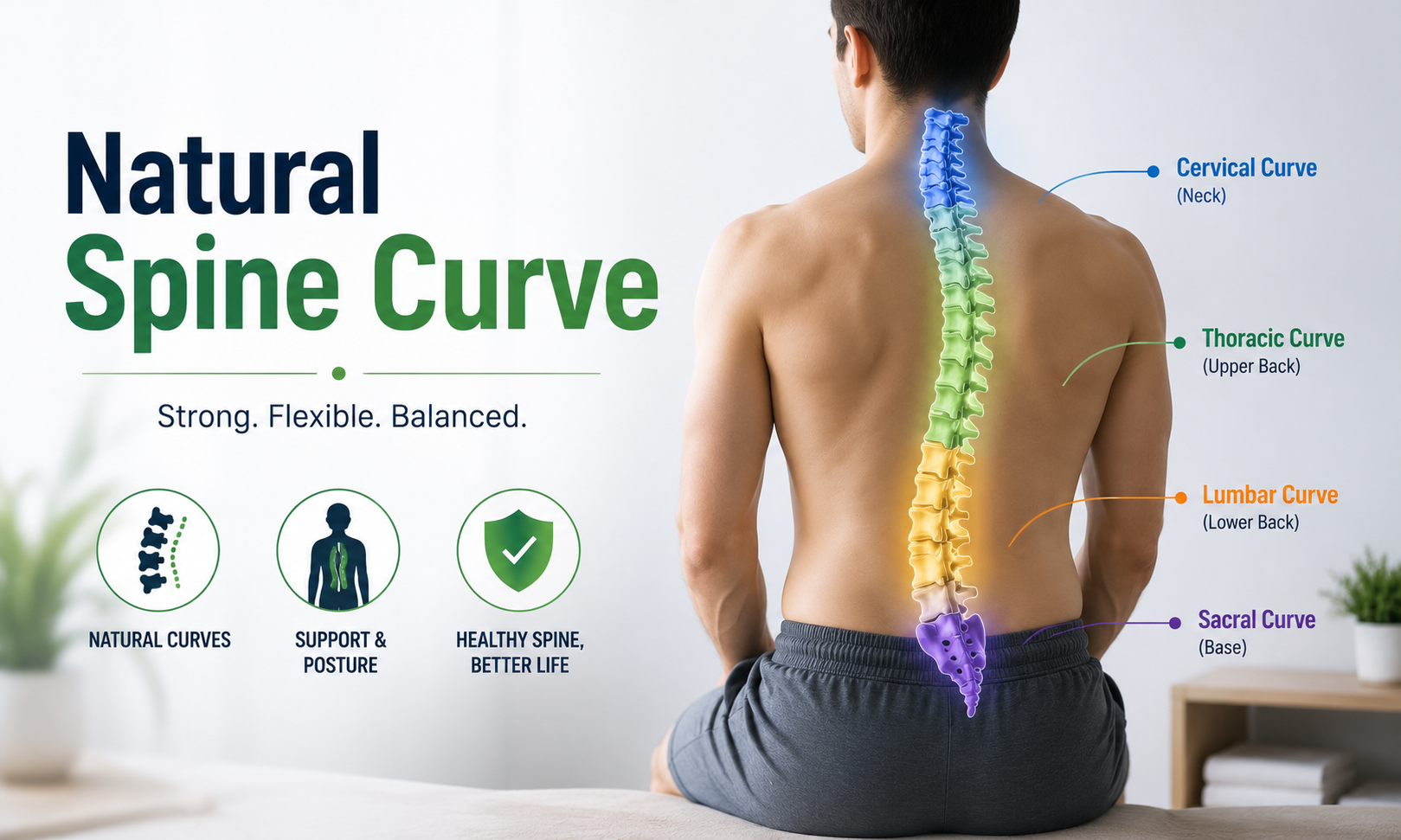
A Natural Spine Curve is an important part of healthy spinal anatomy because a normal spine is not perfectly straight. Its gentle curves help the body balance, move, carry weight, and absorb everyday forces. Here is how the cervical, thoracic, lumbar, and sacral curves fit together, and when a curve may need medical evaluation.
Updated for a U.S. audience in 2026.
If you look at a healthy spine from the side, it usually forms a soft S-shaped profile. The neck and lower back curve inward, while the upper back and sacral area curve outward. These are normal anatomical features, not deformities. From behind, however, the spine should generally look vertically aligned rather than bending noticeably to the left or right.
The spine is also more than a stack of bones. Vertebrae, disks, joints, ligaments, muscles, and nerves work together to support the body and protect the spinal cord. Cleveland Clinic provides an overview of spinal anatomy and function.
Key Takeaways
- A healthy spine normally has curves when viewed from the side. The neck and low back have inward curves called lordosis, while the thoracic and sacral regions curve outward in a kyphotic direction.
- Some sources describe three natural curves because the sacral curve is fixed within the fused sacrum. Anatomically, it is also reasonable to describe four curve regions: cervical, thoracic, lumbar, and sacral.
- Normal spinal curvature varies from person to person and changes with age, body shape, pelvic alignment, and position. A single angle is not enough to diagnose a problem.
- Lordosis and kyphosis can describe normal curve directions, but the same words are also used clinically when a curve becomes excessive or abnormal.
- A sideways structural curve is different. Scoliosis refers to an abnormal side-to-side curvature with vertebral rotation, usually assessed on standing X-rays.
- Pain, progressive deformity, weakness, numbness, walking problems, or new bowel or bladder changes deserve medical evaluation.
What are the natural curves of the spine?
The spine is divided into regions, and each region contributes differently to the body’s side-view alignment.
| Spinal region | Normal curve direction | Common term | Main role |
| Cervical spine (neck) | Curves inward | Cervical lordosis | Balances the head and helps distribute forces through the neck |
| Thoracic spine (upper and mid back) | Curves outward | Thoracic kyphosis | Works with the rib cage and helps position the trunk over the pelvis |
| Lumbar spine (low back) | Curves inward | Lumbar lordosis | Supports much of the upper body and helps with upright posture and movement |
| Sacrum | Curves outward | Sacral kyphosis | Transfers load between the spine and pelvis |
Why does the spine need curves instead of being straight?
The curves help the skeleton keep the head and trunk centered over the pelvis while allowing the body to remain flexible. They also spread mechanical loads across the vertebrae, disks, joints, and supporting muscles. In practical terms, the curved shape helps the spine handle walking, running, lifting, sitting, and changes in direction without behaving like one rigid column.
The exact shape is not identical in everyone. Pelvic anatomy, age, muscle tone, pregnancy, body composition, degenerative changes, prior injury, and the position used during an exam or X-ray can all affect how much curvature is seen.
What does a normal spine look like from the side?
From the side, the cervical and lumbar regions normally bow inward toward the front of the body. This is lordosis. The thoracic region bows in the opposite direction. The sacrum continues the outward curve lower down. Together, these curves create the familiar S-like profile of an upright human spine.
There is no single visual template that every healthy person must match. Clinicians judge alignment in the context of symptoms, age, overall posture, pelvic position, and imaging when imaging is actually needed. Mild differences in curve size can be normal and may cause no pain at all.
How much cervical and lumbar lordosis is considered normal?
Reference ranges depend on how the angle is measured. Cleveland Clinic notes that cervical lordosis is commonly around 30 to 40 degrees and lumbar lordosis around 40 to 60 degrees. These numbers are useful as broad clinical references, not as do-it-yourself cutoffs. Different X-ray techniques, spinal levels, age groups, and pelvic anatomy can produce different measurements.
This is one reason a radiology report or orthopedic evaluation should be interpreted as a whole. A person can fall outside a textbook range and still function well, while another person with an apparently modest change may have symptoms because of disk disease, instability, nerve compression, or another condition.
Why do some sources say the spine has three curves and others say four?
Both descriptions can be correct depending on the level of detail. Patient education materials often focus on three visible mobile regions: the cervical curve in the neck, thoracic curve in the mid back, and lumbar curve in the low back. The sacrum also has a normal outward curve, but because the adult sacral vertebrae are fused and move as one unit, it is often discussed separately.
For everyday posture advice, the three-curve description is common. MedlinePlus notes the natural curves at the neck, mid back, and low back when describing good posture.
When does normal lordosis become hyperlordosis?
Lordosis itself is normal. Hyperlordosis means the inward curve is more pronounced than expected for the person and the region being evaluated. In the lower back, this can create a swayback appearance. In the neck, a change in the usual curve may be seen with posture changes, muscle imbalance, degeneration, trauma, or structural conditions.
An exaggerated curve does not automatically mean something dangerous is happening. Doctors look for pain, stiffness, imbalance, progression, underlying bone or neuromuscular disease, and whether the curve is flexible or fixed. Treatment is directed at the cause and symptoms, not simply at making an X-ray look straighter.
When does normal kyphosis become excessive?
The thoracic spine is supposed to curve outward. Excessive thoracic kyphosis means that outward bend becomes greater than expected. It may develop from postural factors, vertebral compression fractures, osteoporosis, Scheuermann disease, congenital differences, degeneration, or other spinal conditions.
A rounded upper back is therefore not automatically the same as a structural spinal deformity. A clinician may compare standing posture, flexibility, symptoms, and X-rays to distinguish a flexible postural change from a fixed structural curve.
How is scoliosis different from the natural spine curve?
Scoliosis is primarily a side-to-side spinal curvature with rotation of the vertebrae. That is different from the normal front-to-back curves of lordosis and kyphosis. A person with scoliosis can also have altered thoracic kyphosis or lumbar lordosis, so more than one type of alignment change can occur at the same time.
Small asymmetries are common, and a visual check alone cannot measure a scoliosis curve. When scoliosis is suspected, clinicians typically use a standing X-ray and a Cobb angle to quantify the curve and then consider age, skeletal growth, symptoms, curve location, and whether the curve is progressing.
Can posture change the natural curve of your spine?
Posture changes the position of the spine throughout the day. Sitting slumped, looking down at a screen, standing with the pelvis tilted, or holding one position for a long time can temporarily alter how the curves appear and can increase muscle fatigue. That does not mean every postural habit permanently reshapes the spine.
The goal of good posture is not to force the back completely flat. It is to keep the natural curves supported while avoiding unnecessary strain. Frequent movement is usually more realistic than trying to hold one supposedly perfect posture for hours.
Does a flatter or more curved spine always cause back pain?
No. Spinal shape and pain do not have a one-to-one relationship. Many people have mild alignment differences without symptoms, and many people with back pain have no major curvature abnormality. Pain can arise from muscles, disks, facet joints, nerves, fractures, arthritis, inflammation, or other causes.
This is important because posture photos and home curve checks can be misleading. If pain persists, interferes with sleep or activity, follows an injury, or comes with neurological symptoms, an exam is more useful than trying to diagnose the problem from appearance alone.
Can the natural spine curve change with age?
Yes. Spinal alignment can change across the lifespan. Children develop cervical and lumbar lordosis as they gain head control, sit, stand, and walk. In adulthood, disks and joints gradually change, and muscle strength, bone density, vertebral shape, and pelvic position can also change. Older adults may develop increased thoracic rounding, reduced lumbar lordosis, or a forward-shifted posture, particularly when osteoporosis or degenerative disease is present.
Age-related change is not automatically a disease. The clinical concern is whether the change is substantial, progressive, painful, associated with fractures, or affecting balance, walking, breathing, or nerve function.
How do doctors check whether a spine curve is normal?
Evaluation usually begins with history and a physical exam. A clinician may look at shoulder and pelvic level, head position, the side profile of the spine, range of motion, gait, muscle strength, reflexes, and sensation. They may also ask whether the curve changes when you bend, lie down, or consciously correct your posture.
Imaging is not required just to confirm that the spine has normal curves. X-rays are more useful when a structural deformity, fracture, significant degeneration, instability, or scoliosis is suspected. MRI or CT may be ordered when symptoms suggest a nerve, spinal cord, disk, bone, or other structural problem that needs a closer look.
When should you get a spine curve checked?
Consider making a medical appointment if you notice any of the following:
- A visibly increasing curve, hump, or sideways asymmetry
- Persistent neck or back pain that is not improving
- Pain that repeatedly travels into an arm or leg
- New numbness, tingling, weakness, or problems with balance or walking
- Loss of height or sudden back pain in someone at risk for osteoporosis
- A spinal change after a significant fall, collision, or other injury
- A curve in a growing child or teenager that appears to be progressing
Seek urgent medical care for new loss of bowel or bladder control, marked weakness or paralysis, severe numbness around the groin or saddle area, or major spinal symptoms after trauma. These can signal serious nerve or spinal cord involvement.
For context on neurological warning signs involving the spinal cord, see the National Institute of Neurological Disorders and Stroke overview of spinal cord injury symptoms.
How can you support a healthy natural spine curve?
Most people do not need to actively reshape their spine. The more useful goal is maintaining strength, mobility, bone health, and comfortable movement. Regular physical activity, resistance training appropriate for your health status, adequate calcium and vitamin D intake, avoiding tobacco, and addressing osteoporosis risk can all support the structures that keep the spine functioning.
For desk work, change positions regularly, place screens where you do not have to constantly crane the neck, support the low back if that feels comfortable, and keep frequently used items within easy reach. For lifting, use a stable stance and keep the load close to the body rather than twisting while bent forward.
If a specific curve abnormality is causing symptoms, a physical therapist may focus on strength, flexibility, movement control, and activity modification. Bracing or surgery is reserved for selected structural conditions and depends on the diagnosis, severity, age, progression, and neurological impact.
Common Questions About Natural Spine Curves
Should your back be completely straight when standing?
No. From the side, a healthy back should retain its normal cervical, thoracic, and lumbar curves. From behind, the spine should generally appear vertically aligned rather than having a prominent side-to-side bend.
Is lumbar lordosis normal?
Yes. Lumbar lordosis is the normal inward curve of the lower back. The term becomes confusing because people sometimes use lordosis to mean excessive lordosis. Clinically, the distinction depends on how pronounced the curve is and whether it is associated with symptoms or a structural condition.
Can sleeping position ruin the natural curve of your spine?
There is no evidence that one ordinary sleeping position permanently ruins a healthy spine curve. Comfort matters more. A mattress and pillow should allow you to sleep without excessive strain, and people with a specific spinal condition may need individualized advice.
Can exercises restore a normal spine curve?
Exercise can improve strength, flexibility, endurance, and postural control, but whether it can change a measured spinal curve depends on the cause. Flexible postural changes may respond differently from fixed structural deformities. A physical therapist or spine specialist can determine what is realistic for a particular condition.
Is a curved spine always scoliosis?
No. The spine normally curves forward and backward when viewed from the side. Scoliosis describes an abnormal side-to-side curvature with vertebral rotation, not the ordinary lordotic and kyphotic curves seen in healthy anatomy.
The Bottom Line
A natural spine curve is a normal part of human anatomy. The neck and lower back bend inward, the thoracic and sacral regions bend outward, and these curves help the body balance and move efficiently. The presence of a curve is not the problem. Concern arises when a curve becomes excessive, unusually flat, structurally rotated, progressive, painful, or associated with neurological symptoms.
If you are worried about the shape of your spine, especially because of pain or a visible change, a clinician can assess alignment in context rather than relying on appearance or a single angle. For most people, maintaining regular movement, muscle strength, bone health, and comfortable posture is more useful than trying to force the spine into a perfectly straight shape.
Medical Note
This article is for general educational purposes and is not a substitute for medical advice, diagnosis, or treatment. Seek professional care for persistent pain, progressive spinal deformity, neurological symptoms, or concerns after an injury.
Editorial Sources
The reference article from HealthCentral was used to identify search intent and core topic coverage. Medical details were updated using current patient education from Cleveland Clinic, MedlinePlus, the National Institute of Neurological Disorders and Stroke, and other U.S. clinical references available in 2026.