
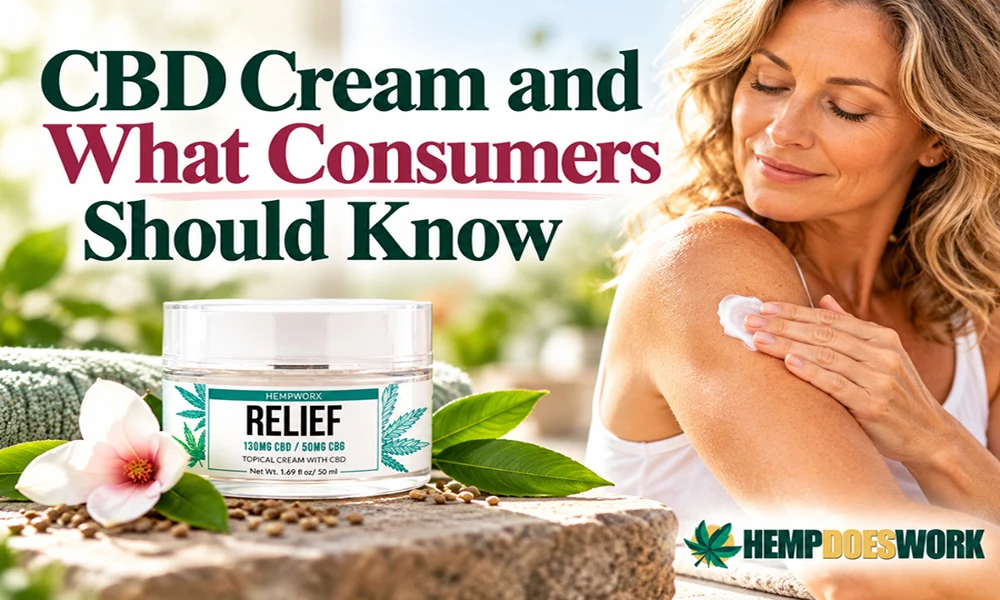
CBD cream has become a familiar product in the growing market for hemp-derived wellness products. From moisturizing lotions to targeted topical formulations, consumers now encounter CBD-infused skincare products in a wide variety of stores and online shops.
But what exactly is CBD cream, how does it differ from other hemp products, and what should shoppers consider before purchasing?
With so many formulations, concentrations, and marketing claims available, understanding the basics can help consumers make more informed decisions.
CBD creams are not all the same. Their ingredients, cannabinoid content, manufacturing quality, and intended uses can vary considerably.
This guide explains what CBD cream is, how topical CBD products are formulated, what researchers currently know, and how to evaluate product labels before buying.
What Is CBD Cream?
CBD cream is a topical product containing cannabidiol, commonly called CBD.
CBD is one of the naturally occurring cannabinoids found in the cannabis plant, including hemp varieties.
Unlike THC, the cannabinoid primarily responsible for marijuana’s intoxicating effects, CBD does not typically produce a high.
In topical products, CBD is combined with a cream, lotion, balm, or similar base designed for application to the skin.
These products may also contain moisturizing ingredients, botanical extracts, essential oils, or other compounds.
Some are marketed primarily as skincare products, while others are promoted for localized comfort or post-activity routines.
However, the presence of CBD does not automatically establish that a cream can treat pain, inflammation, or other medical conditions.
The effectiveness and safety of a product depend on its formulation, intended use, and supporting evidence.
How Is CBD Cream Different From CBD Oil?
CBD creams and CBD oils are often grouped together, but they are not necessarily used in the same way.
CBD oil is typically formulated for oral use, although some products are specifically designed for topical application.
CBD cream, by contrast, is made to be applied directly to the skin.
A cream usually contains water, oils, emulsifiers, and other ingredients that create a spreadable consistency.
Balms and salves may have a thicker, oil-based texture.
The formulation influences how the product feels, how easily it spreads, and how its ingredients interact with the skin.
Consumers should always follow the product’s labeled directions rather than assuming an oral CBD oil and a topical CBD cream are interchangeable.
Understanding How Topical CBD Works
Researchers are studying how cannabinoids interact with biological systems, including the endocannabinoid system.
This system includes receptors, signaling molecules, and enzymes involved in several physiological processes.
Cannabinoid-related signaling pathways are also present in the skin.
Scientists have investigated whether topical CBD may influence certain local biological responses.
However, much of the research remains preliminary, and results from laboratory or animal studies cannot automatically be applied to humans.
One important distinction involves topical products and transdermal products.
A conventional topical cream is generally intended to act on or near the area where it is applied.
A transdermal product is designed to deliver ingredients through the skin into systemic circulation.
Most CBD creams should not be assumed to provide meaningful whole-body CBD exposure.
Consumers should be cautious about claims that applying a cream will produce effects throughout the body.
Why People Are Interested in CBD Cream
People explore CBD creams for different reasons.
Some are interested in incorporating hemp-derived ingredients into a skincare routine.
Others prefer topical products because they can be applied to a particular area without swallowing a capsule or using an oral tincture.
CBD creams are also frequently marketed to physically active consumers.
However, popularity should not be confused with proven medical effectiveness.
Although early research has explored topical cannabinoids for certain applications, high-quality human evidence supporting many commercial CBD cream claims remains limited.
Products marketed as treatments for arthritis, chronic pain, eczema, or other medical conditions require careful evaluation.
Consumers should not replace prescribed treatments with CBD creams without discussing the decision with a qualified healthcare professional.
Full-Spectrum, Broad-Spectrum, and CBD Isolate
CBD creams may contain different types of hemp extracts.
Full-spectrum CBD generally refers to an extract containing CBD along with other naturally occurring hemp compounds, potentially including small amounts of THC.
Broad-spectrum CBD typically contains multiple hemp-derived compounds while being processed to remove THC or reduce it to very low levels.
CBD isolate is a purified form of cannabidiol without the broader range of compounds found in hemp extracts.
These categories can help describe a product, but they do not guarantee quality or effectiveness.
Actual cannabinoid content depends on the manufacturing process and finished formulation.
Even products marketed as THC-free may contain detectable THC if manufacturing or labeling controls are inadequate.
Consumers concerned about THC exposure should review independent laboratory results rather than relying solely on marketing language.
What Does CBD Concentration Mean?
CBD creams are often labeled with a total amount of CBD, such as 500, 1,000, or 1,500 milligrams per container.
This number usually describes the total CBD content in the entire package, not the amount delivered in one application.
For example, a cream containing 1,000 milligrams of CBD in a 100-gram container has a different concentration from a cream containing the same amount in a 50-gram container.
Comparing products by total CBD alone can therefore be misleading.
A useful label should identify the amount of CBD in the container, the container size, and ideally the concentration.
Higher concentrations do not automatically mean better results.
There is no universally established effective dose for most uses of commercial CBD creams.
Why Other Ingredients Matter
CBD is only one component of a topical formulation.
Many creams contain moisturizing ingredients such as glycerin, shea butter, or plant-derived oils.
Others include menthol, camphor, essential oils, or botanical extracts.
These additional ingredients can influence the product’s texture, fragrance, and effects on the skin.
For example, menthol can create a cooling sensation independent of CBD.
Consumers who experience a cooling or warming effect should not automatically attribute that sensation to cannabidiol.
Fragrances and essential oils may also cause irritation or allergic reactions in some individuals.
People with sensitive skin should carefully review ingredient lists and consider testing a small area before wider application.
How to Evaluate CBD Cream Quality
One of the most important considerations when purchasing CBD cream is product transparency.
A reputable manufacturer should provide clear information about the ingredients, cannabinoid content, and testing procedures.
A certificate of analysis, often called a COA, is a laboratory report that may document cannabinoid concentrations and screening for certain contaminants.
Depending on the testing performed, a COA may include results for pesticides, heavy metals, residual solvents, or microbial contamination.
Consumers should look for a report associated with the specific product batch whenever possible.
The report should also be reasonably current and issued by an independent laboratory.
Third-party testing cannot prove that a CBD cream provides a particular health benefit, but it can help consumers evaluate product identity and quality.
Learning More About Hemp-Derived CBD Products
The CBD marketplace includes topical creams, balms, lotions, oils, and other formulations.
Understanding product differences can make it easier to compare ingredients and identify which questions to ask before purchasing.
Consumers interested in exploring hemp-derived products and learning more about CBD formulations can visit Hemp Does Work.
Educational resources and product information can provide a starting point for understanding labels, concentrations, and common terminology.
However, consumers should continue to evaluate product claims independently and consider the available scientific evidence.
CBD Cream Safety and Precautions
Although topical CBD products are widely marketed, their safety has not been fully established for every formulation or long-term use.
Some people may experience skin irritation, redness, itching, or allergic reactions.
These reactions may result from CBD, other cannabinoids, fragrances, preservatives, or additional ingredients.
Consumers should avoid applying products to broken skin or sensitive areas unless the product is specifically intended for that use.
They should also avoid contact with the eyes and follow the manufacturer’s directions.
CBD can interact with certain medications when sufficient amounts reach the bloodstream. The extent of systemic absorption from conventional creams is not well established and may vary by formulation.
Pregnant or breastfeeding individuals should avoid CBD products because of safety concerns and insufficient evidence.
Anyone managing a medical condition or taking prescription medications should seek professional guidance before using CBD for a health-related purpose.
Understanding CBD Regulations and Product Claims
CBD regulations can be confusing because federal and state requirements differ.
In the United States, hemp and hemp-derived products are subject to multiple regulatory considerations.
A product being derived from hemp does not automatically make every CBD formulation lawful to market.
The FDA has approved a prescription CBD medication for certain seizure disorders, but that approval does not extend to ordinary CBD creams.
Commercial CBD products should not be assumed to have FDA approval for treating pain, inflammation, skin diseases, or other medical conditions.
Consumers should be particularly cautious about products promising to cure diseases or replace established treatments.
Regulatory requirements and state restrictions may also change, making current product information important.
CBD Cream Versus Traditional Moisturizers
Some consumers wonder whether CBD cream provides advantages over a conventional moisturizer.
Traditional moisturizers may contain ingredients with well-established roles in maintaining the skin barrier and reducing moisture loss.
CBD creams often contain many of those same ingredients.
If a CBD cream makes skin feel softer or more comfortable, the moisturizing base may contribute significantly to that experience.
Research has explored potential effects of CBD on skin biology, but there is not enough strong clinical evidence to conclude that CBD creams are consistently superior to conventional moisturizers.
For basic dry-skin care, fragrance-free moisturizers with established ingredients may be a practical starting point.
Consumers considering CBD creams should evaluate whether the additional cost is justified by the product’s ingredients and evidence.
Comparing CBD Products Before Buying
With numerous CBD brands competing for attention, comparison shopping can be useful.
Rather than selecting a cream solely because it has the highest advertised CBD content, consumers should examine the complete formulation.
Important considerations include ingredient transparency, batch-specific laboratory testing, container size, price, and manufacturer reputation.
Return policies and customer service may also influence the purchasing experience.
For readers looking to explore additional information about hemp-derived CBD products and how different formulations compare, Help From Hemp can serve as another resource.
Consumers should also check whether a company clearly explains its sourcing and testing practices.
A responsible purchasing decision involves understanding both what the product contains and what its marketing claims can reasonably support.
Common Mistakes Consumers Should Avoid
One common mistake is assuming that every CBD cream contains the amount of cannabidiol advertised on the label.
Independent testing helps address this concern.
Another mistake is confusing total CBD per container with CBD concentration.
Consumers may also assume that full-spectrum products are automatically more effective than isolate formulations.
Although different extracts have different compositions, strong evidence supporting broad claims of superiority remains limited.
Finally, some shoppers overlook the importance of other ingredients.
A product may contain CBD but also include fragrances or botanical compounds that are unsuitable for sensitive skin.
Reading the complete label is more useful than focusing on one featured ingredient.
Final Thoughts
CBD cream is a growing category of hemp-derived topical products, but consumers should approach it with the same care they would use when evaluating other wellness products.
Understanding the difference between CBD cream and CBD oil, recognizing various hemp extract types, and reviewing ingredient lists can help shoppers make informed choices.
Independent laboratory testing is particularly important for verifying cannabinoid content and evaluating certain quality concerns.
At the same time, consumers should recognize that scientific evidence supporting many commercial CBD cream claims remains limited.
A product’s popularity, price, or CBD concentration does not guarantee effectiveness.
By focusing on transparency, realistic expectations, and reliable information, consumers can make better decisions about whether CBD cream belongs in their personal skincare or wellness routine.
