A practical 2026 guide to interpreting walking heart-rate numbers, using pace, symptoms, recovery, medications, and personal trends instead of chasing one universal target.
Two people can walk the same block at the same speed and see very different numbers on their watches. That does not automatically mean one heart is healthy and the other is not. Your heart rate when walking reflects how hard your body is working at that moment, but it is also shaped by age, fitness, temperature, stress, sleep, medications, illness, terrain, and even how accurately a wearable is sitting on your wrist.
The most useful question is not, “What number is normal for everyone?” It is, “Does this number fit my age, effort, symptoms, and usual pattern?” This guide turns that question into a simple four-number dashboard you can use on everyday walks.
| KEY TAKEAWAYS
· There is no single normal walking heart rate. The same reading can represent an easy stroll for one person and hard exercise for another. · For many adults, a brisk walk falls near 50% to 70% of estimated maximum heart rate, but age-based formulas are only starting estimates. · The talk test is often more useful than a watch: moderate effort usually means you can talk in sentences but cannot comfortably sing. · A sudden change from your usual walking heart rate matters more than one isolated reading, especially when it comes with chest discomfort, faintness, unusual shortness of breath, or palpitations. · Beta blockers and some other medicines can make standard heart-rate zones misleading, so effort and clinician-guided targets may be safer. |
Start With a Four-Number Walking Dashboard
A single peak reading is easy to misinterpret. A better approach is to track four numbers under similar conditions. Together, they show how your cardiovascular system responds before, during, and after a walk.
| Number to Track | How to Measure It | Why It Helps |
| 1. Resting baseline | Your heart rate after sitting quietly for several minutes, ideally at a similar time of day. | Shows your normal starting point and helps identify unusual day-to-day changes. |
| 2. Easy-walk rate | Your typical rate during a relaxed, conversational walk on level ground. | Creates a personal reference for light effort. |
| 3. Brisk-walk rate | Your rate after several minutes at a purposeful pace that raises breathing. | Helps estimate whether the walk is moderate or vigorous for you. |
| 4. Recovery trend | How quickly the number begins to fall after you slow down or stop. | A consistent recovery pattern is more informative than chasing one exact cutoff. |
Record these numbers for several walks before deciding that a reading is “too high” or “too low.” Trends are most meaningful when the route, pace, weather, and time of day are reasonably similar.
What Heart-Rate Range Is Typical During a Walk?
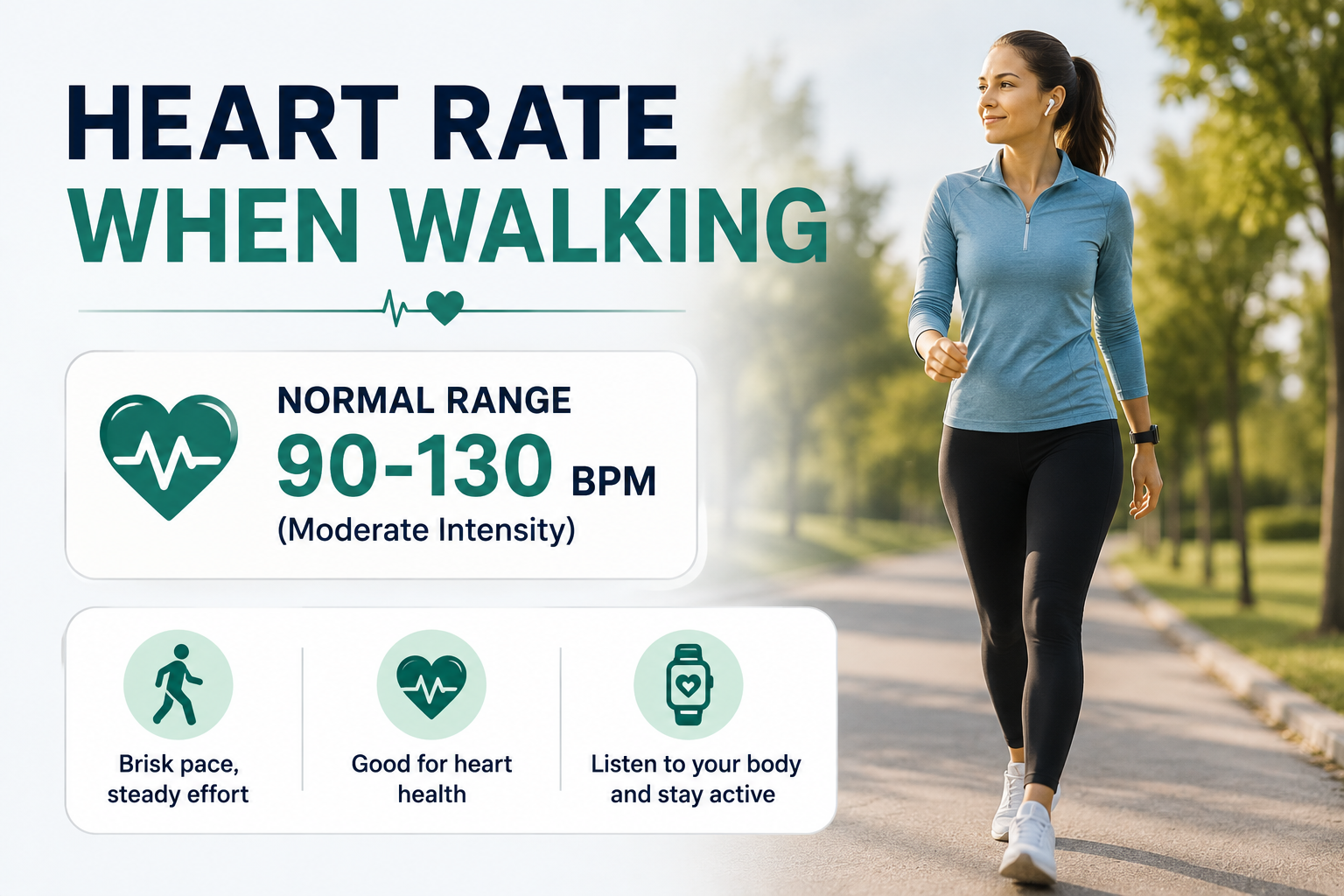
Walking can range from very light activity to vigorous exercise. A slow stroll may barely raise your pulse, while fast walking uphill can push the same person into a high-intensity zone. The American Heart Association target heart-rate chart estimates moderate intensity at about 50% to 70% of maximum heart rate and vigorous intensity at about 70% to 85%. A common estimate for maximum heart rate is 220 minus your age.
The chart below shows rough zones using that formula. These are averages, not medical limits. Your actual maximum may be higher or lower, and medications or health conditions can change the response.
| Age | Estimated Max | Moderate Walk Zone 50% to 70% |
Vigorous Zone 70% to 85% |
| 20 | 200 bpm | 100 to 140 bpm | 140 to 170 bpm |
| 30 | 190 bpm | 95 to 133 bpm | 133 to 162 bpm |
| 40 | 180 bpm | 90 to 126 bpm | 126 to 153 bpm |
| 50 | 170 bpm | 85 to 119 bpm | 119 to 144 bpm |
| 60 | 160 bpm | 80 to 112 bpm | 112 to 136 bpm |
| 70 | 150 bpm | 75 to 105 bpm | 105 to 128 bpm |
| 80 | 140 bpm | 70 to 98 bpm | 98 to 119 bpm |
Example: For a 50-year-old, the simple formula estimates a maximum of 170 bpm. A moderate zone is roughly 85 to 119 bpm. A brisk uphill walk could move into the vigorous range, while a flat easy walk may stay below 85 bpm and still provide worthwhile movement.
Can You Judge a Good Walking Pace Without Doing Math?
Yes. Heart-rate formulas are helpful, but they are not the only way to measure intensity. The CDC talk test is simple and works even when a wearable is inaccurate or medication changes your pulse response.
| LIGHT
You can talk and sing comfortably. Easy stroll, warm-up, or recovery walk. |
MODERATE
You can talk in sentences, but singing is difficult. Purposeful brisk walking for many adults. |
VIGOROUS
You can say only a few words before pausing for breath. Fast uphill walking or race walking for many adults. |
A 0-to-10 effort scale is another option. Light walking often feels like 2 or 3, moderate effort like 4 to 6, and vigorous effort like 7 or 8. For general fitness, many walks can stay in the moderate range. Beginners may need to start lower and build gradually.
Why Does the Same Route Produce Different Numbers?
A higher-than-usual reading is not automatically a heart problem. Before judging the number, look for a change in workload or body conditions.
Pace and incline: Faster steps, hills, stairs, soft sand, and uneven trails recruit more muscle and raise oxygen demand.
Heat and humidity: Your cardiovascular system works harder to move heat toward the skin, and dehydration can raise heart rate further.
Fitness and recent training: A fitter heart often needs fewer beats for the same route. Fatigue or several hard days in a row may temporarily raise the response.
Sleep, stress, caffeine, and nicotine: Poor sleep, emotional stress, stimulants, and nicotine can increase heart rate before the walk even begins.
Illness and recovery: Fever, a respiratory infection, anemia, thyroid problems, and other conditions may make an ordinary walk feel harder.
Medications: Beta blockers can keep the rate lower, while stimulants, decongestants, and some other medicines can push it higher.
Wearable fit and motion: A loose band, cold skin, arm movement, tattoos, sweat, or poor sensor contact may create spikes that are not your true pulse.
What Do Common Walking Numbers Mean?
Numbers such as 100, 120, 140, or 160 bpm are often searched in isolation, but age and effort change their meaning. Use the examples below as context, not as a diagnosis.
| Reading During a Walk | Possible Context | What to Check |
| Around 90 to 110 bpm | Could be light or moderate effort for many middle-aged and older adults, or a very easy walk for a younger adult. | Age, pace, breathing, and whether the number is typical for you. |
| Around 110 to 130 bpm | Often falls in a moderate zone for many adults, but may be vigorous for an older adult or easy for a fit younger adult. | Use the talk test and compare with your estimated zone. |
| Around 130 to 150 bpm | May reflect fast walking, hills, heat, low fitness, or vigorous effort. It can also be unexpectedly high if the walk feels easy. | Slow down, reassess symptoms, and see whether the number falls appropriately. |
| Above 150 bpm | Can occur during hard walking in younger people, but it deserves more context in older adults, beginners, or anyone with heart symptoms. | Stop if you feel unwell. Recheck manually if the wearable reading seems implausible. |
A number is more concerning when it is new, disproportionate to the effort, difficult to bring down after slowing, or accompanied by symptoms. A familiar rate during a hard hill with no symptoms is different from the same rate during a slow flat walk that suddenly feels difficult.
When Can a Lower Walking Heart Rate Be Normal?
A lower number is common in well-conditioned people because the heart can pump more blood with each beat. It is also expected in people taking beta blockers and some rhythm or blood-pressure medicines. In those situations, a standard age-based zone may underestimate how hard the walk feels.
Do not push harder simply to force the watch into a calculated zone. If you take a medicine that slows heart rate, ask the prescribing clinician whether you should use a personalized target, the talk test, or a perceived-effort scale. A low number needs medical review when it comes with fainting, dizziness, unusual weakness, confusion, chest discomfort, or exercise intolerance.
When Is a High Walking Heart Rate Worth Discussing With a Clinician?
Make an appointment when your rate repeatedly runs much higher than your personal baseline on the same easy route, especially if the change lasts for days or weeks. A clinician may review hydration, medications, anemia, thyroid function, infection, heart rhythm, blood pressure, and other possible contributors.
Stop walking and seek urgent help if you develop:
- Chest pressure, squeezing, pain, or discomfort, especially if it spreads to the arm, back, neck, jaw, or stomach.
- Severe or unusual shortness of breath, fainting, near-fainting, confusion, or sudden weakness.
- A sustained racing or irregular heartbeat with dizziness, chest discomfort, or difficulty breathing.
- Possible stroke signs such as facial drooping, one-sided weakness, or trouble speaking.
Call 911 for symptoms that may represent a heart attack, stroke, or another emergency. Do not use a smartwatch reading to rule out a serious problem.
How Should You Check Your Heart Rate During a Walk?
Wearables are convenient for trends, but they can lag or produce motion-related spikes. Use the watch as one data source and compare it with how you feel.
- Wear the device snugly, about one finger-width above the wrist bone, and allow it to settle before checking the reading.
- Walk at a steady pace for several minutes before using the number to judge intensity.
- If the display suddenly jumps but you feel unchanged, slow down and check your pulse manually at the wrist or side of the neck.
- Count beats for 30 seconds and multiply by two. If the rhythm feels irregular, count for a full 60 seconds.
- Record pace, route, weather, symptoms, and medications along with the number. Context makes the data useful.
A Seven-Day Baseline Plan
Instead of reacting to one watch alert, use a short baseline week. This creates a practical profile without turning every walk into a stress test.
| Days | Walk | Record |
| 1 to 2 | Easy, flat 15- to 20-minute walk. | Resting rate, average walking rate, talk-test level, and symptoms. |
| 3 to 4 | Repeat the same route at a purposeful but comfortable pace. | Average rate, highest stable rate, and recovery after slowing. |
| 5 | Rest or take a very easy walk. | Resting rate, sleep, stress, illness, and soreness. |
| 6 to 7 | Repeat one easy and one brisk walk under similar conditions. | Compare with earlier days and note any consistent pattern. |
If your usual easy-walk rate is stable and you feel well, the trend is more reassuring than any internet chart. If your rate changes sharply without an obvious reason, bring the log and wearable data to a healthcare professional.
Frequently Asked Questions
Is 120 bpm normal while walking?
It can be. For many adults, 120 bpm falls in a moderate or vigorous exercise zone depending on age. Check the pace, incline, symptoms, medications, and whether 120 is typical for you.
Is 140 bpm too high for a walk?
Not automatically. It may be expected during fast uphill walking in a younger or fit adult. It may be unusually high during an easy flat walk, particularly for an older adult or someone taking heart-rate-lowering medication.
Why is my walking heart rate higher in summer?
Heat and humidity increase cardiovascular strain and can raise heart rate. Dehydration adds to the effect. Slow the pace, choose cooler hours, and follow medical advice about fluid intake if you have heart or kidney disease.
Why is my heart rate lower even though I am walking faster?
Improved fitness may allow your heart to pump more efficiently. A lower rate can also reflect cooler weather, better recovery, a downhill route, or medication. Compare several similar walks rather than one session.
Should I worry about a smartwatch spike?
A brief spike may be sensor error, especially if your effort and symptoms did not change. Slow down, check the fit, and compare with a manual pulse. Repeated spikes, an irregular pulse, or symptoms deserve medical review.
How much walking should adults aim for?
Current U.S. guidance generally recommends at least 150 minutes a week of moderate-intensity aerobic activity, such as brisk walking, plus muscle-strengthening activity on at least two days. Some activity is better than none, and people with chronic conditions may need an individualized plan.
The Bottom Line
A healthy walking heart rate is not one magic number. It is a pattern that makes sense for your age, pace, terrain, medications, symptoms, and fitness level. Use an estimated zone as a starting point, confirm intensity with the talk test, and pay attention to changes from your own baseline.
Most importantly, do not ignore how you feel. Chest discomfort, fainting, severe breathlessness, neurologic symptoms, or a racing or irregular heartbeat with symptoms requires prompt medical attention, regardless of what a wearable reports.
| Medical note: This article is for general education and is not a diagnosis or a personalized exercise prescription. People with heart disease, lung disease, diabetes, pregnancy, significant deconditioning, or other chronic conditions should ask a healthcare professional about safe exercise intensity. |