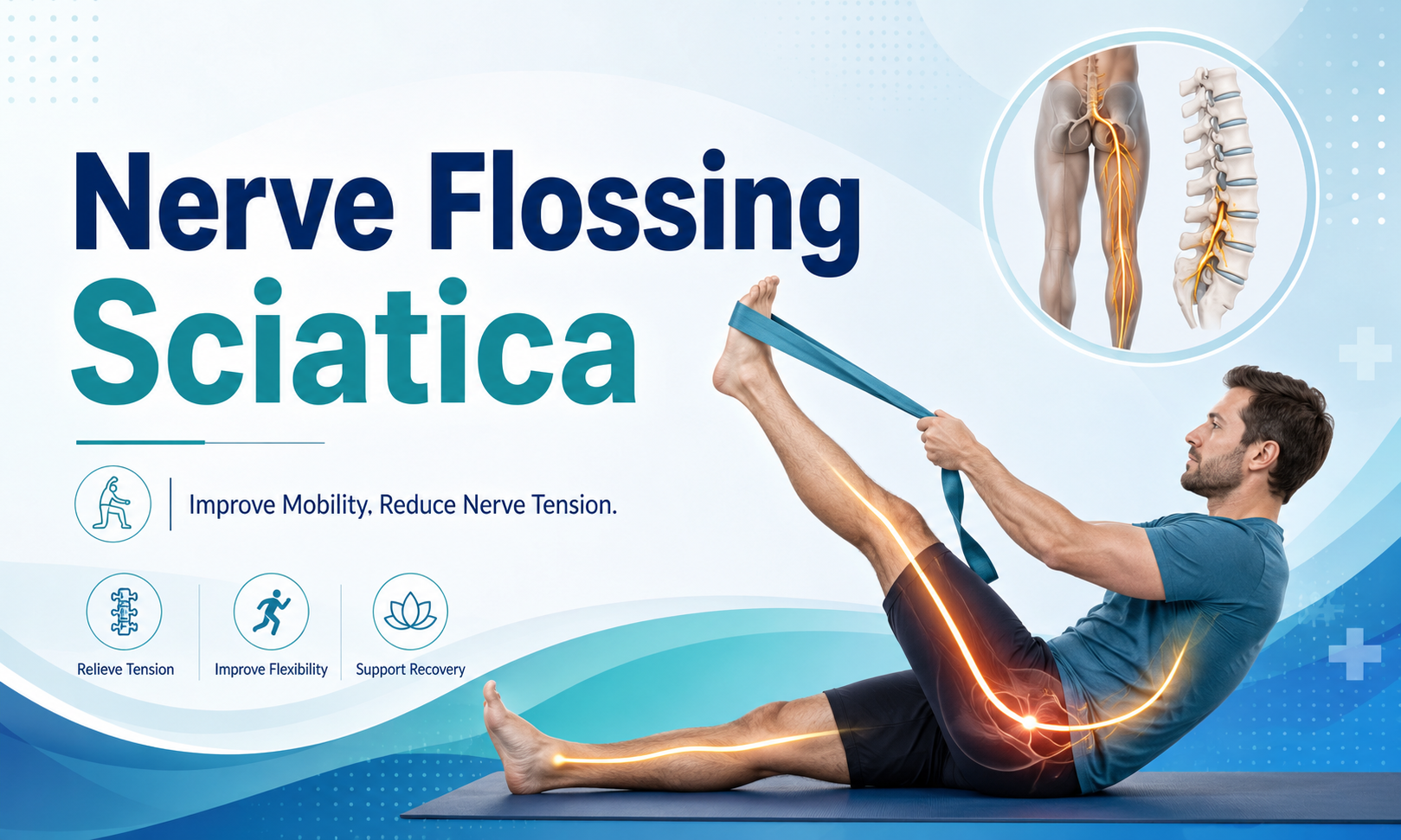
What the exercises can do, how to perform gentle sliders, and when radiating leg pain needs professional care
| Quick answer
People searching for nerve flossing sciatica exercises are usually looking for a way to calm shooting, burning, or tingling leg pain. Gentle nerve sliders may reduce pain and disability for some people with lumbar radiculopathy, especially when they are added to a broader rehabilitation plan. They do not move a slipped disk back into place, remove spinal stenosis, or replace a diagnosis. The safest rule is simple: glide the nerve through a comfortable range, never force a stretch, and stop when symptoms become sharper or travel farther down the leg. |
Key Takeaways
| · Nerve flossing, also called neural mobilization or nerve gliding, uses repeated coordinated movements rather than a long held stretch.
· Research suggests neural mobilization can improve pain and disability in lumbar radiculopathy, but study methods vary and the technique works best as part of conservative care. · A slider is generally gentler than a tensioner because one end of the nerve pathway is lengthened while the other end is slackened. · A mild pulling or tingling sensation may occur, but the exercise should not create sharp pain, lasting numbness, new weakness, or symptoms that spread farther into the foot. · Bladder or bowel changes, saddle-area numbness, rapidly worsening weakness, or symptoms in both legs require urgent medical evaluation. |
Start With the Pain Pattern, Not the Exercise
Sciatica is a symptom pattern, not a single disease. It usually refers to pain, tingling, numbness, or weakness that follows a nerve-root pathway from the lower back or buttock into one leg. A herniated disk is a common cause, but spinal stenosis, spondylolisthesis, injury, and other conditions can produce a similar pattern. Some hip, hamstring, or deep-gluteal problems can also imitate sciatica.
That distinction matters because nerve flossing is not appropriate for every source of leg pain. A clinician may use your symptom history, strength, reflexes, walking pattern, and tests such as the straight-leg raise to decide whether a nerve root is involved. Imaging is not automatically required for every new episode, but it may be considered when symptoms are severe, progressive, unusual, or not improving.
| A useful self-check
Sciatica commonly affects one side and may feel electric, burning, or shooting. Pain that remains only in the low back, without leg symptoms, is less typical of sciatica. Calf swelling, redness, fever, unexplained weight loss, or pain after major trauma deserves medical assessment because another condition may be responsible. |
What Is Nerve Flossing Actually Trying to Change?
Peripheral nerves are not rigid wires. They normally slide relative to nearby muscles, joints, connective tissue, and the spinal canal as the body moves. When a nerve root is irritated, the nervous system may become more sensitive to movement and mechanical load. Nerve flossing uses a sequence of joint motions intended to expose the neural tissue to small, controlled changes in tension and movement.
The goal is not to stretch the sciatic nerve as far as possible. Aggressive stretching can increase symptoms. A slider alternates tension between two ends of the nerve pathway, such as moving the knee and neck in opposite directions. A tensioner lengthens the pathway at both ends and is more demanding. For home use, a gentle slider is usually the more conservative starting point, while tensioners are better selected and dosed by a physical therapist.
Does the research show that nerve flossing works?
The evidence is promising but not definitive. A systematic review of neural mobilization for low back and radicular pain found that most included studies reported improved outcomes when neural mobilization was added to conservative treatment, although the studies differed in technique, dosing, diagnosis, and quality. A later meta-analysis in lumbar radiculopathy also reported reductions in pain and disability. These findings support nerve flossing as a possible adjunct, not as a guaranteed cure or a replacement for strength, activity modification, education, medication when appropriate, or treatment of the underlying cause.
Read the research summary on PubMed for a detailed review of neural mobilization in lumbar radiculopathy.
Use This Traffic-Light Check Before You Begin
| Green: reasonable to discuss or try gently | Yellow: get individualized guidance | Red: do not self-treat |
| · One-sided leg symptoms that are mild or improving
· You already have a sciatica diagnosis · Movement does not increase symptoms after you stop |
· Pregnancy or recent childbirth
· Recent spine, hip, or hamstring surgery · Diabetes-related neuropathy, balance problems, or uncertain diagnosis · Pain is severe, persistent, or repeatedly returning |
· New bladder or bowel control problems
· Numbness around the groin, genitals, or anus · Severe or rapidly worsening weakness · Symptoms in both legs or after major trauma |
Three Gentle Sciatic Nerve Slider Options
These are examples, not a personalized prescription. Choose one movement, use a small range, and move slowly. Do not perform all three simply because they are listed. A physical therapist can determine which position matches your symptom behavior and whether another exercise should come first.
| 1 | Chair-Based Knee and Neck Slider
Best suited for: people who can sit comfortably and want a simple, low-load starting position. 1. Sit tall near the front of a stable chair with both feet on the floor. 2. Gently straighten the affected knee while pointing the toes slightly away from you and looking upward. 3. Return the foot to the floor as you slowly bring your chin toward your chest. 4. Move back and forth smoothly without holding either end position. Movement cue: Think motion, not stretch. The neck and leg move in opposite directions to limit sustained tension. Stop or reduce the range if: pain becomes sharp, tingling intensifies, numbness lingers, or the symptoms travel farther toward the toes. |
| 2 | Supported Supine Leg Slider
Best suited for: people who tolerate lying on their back better than sitting. 1. Lie on your back with both knees bent and your head supported in a neutral position. 2. Bring the affected thigh toward you and support it behind the knee with both hands. 3. Slowly straighten the knee only as far as comfortable while pointing the toes away. 4. Bend the knee again as you gently bring the toes toward the shin. 5. Keep the thigh supported and avoid pulling the leg toward your chest. Movement cue: The knee and ankle alternate so the nerve pathway glides rather than staying under maximum tension. Stop or reduce the range if: you feel a sudden electric jolt, the back arches or braces strongly, or symptoms remain worse after the set. |
| 3 | Standing Step Slider
Best suited for: people with good balance whose symptoms are not aggravated by standing. 1. Place the heel of the affected leg on a low, stable step. Keep the knee slightly soft rather than locked. 2. Stand tall and hold a wall or counter for balance. 3. Point the toes gently as you lift the chest and look slightly upward. 4. Then bring the toes toward you as you allow the chin and upper back to round only a little. 5. Use a very small range at first and return to neutral between repetitions. Movement cue: Stay relaxed through the shoulders and keep the movement rhythmic. This is not a hamstring flexibility test. Stop or reduce the range if: balance feels uncertain, the back pain spikes, or the leg develops increasing weakness or numbness. |
How Much Nerve Flossing Is Enough?
There is no universally proven dose. Research protocols and clinical programs use different positions, repetition counts, and treatment periods. A conservative starting point is often a few slow repetitions of one slider, followed by a check of how the leg feels during the next several minutes and later that day. A therapist may progress the range or repetitions only if symptoms remain stable or improve.
| During the movement | After the movement |
| · Use a comfortable, non-forced range.
· Keep breathing and avoid bracing. · A light, brief pull may be acceptable. · Sharp, burning, or escalating pain is not a goal. |
· Symptoms should settle quickly.
· The leg should not feel more numb or weak. · Pain should not spread farther down the limb. · A next-day flare means the dose was probably too high. |
What should improvement look like?
Useful change is more than touching your toes. You may notice that sitting is easier, walking feels less guarded, the leg pain is less intense, or symptoms do not travel as far down the limb. Some people gain range immediately, while meaningful pain and function changes may take repeated sessions within a broader recovery plan. Stop judging the exercise by how far you can stretch and track daily activities instead.
Five Mistakes That Turn a Slider Into an Irritant
Holding the end position
Nerve flossing is typically a repeated glide. Holding a strong position turns it into more of a sustained tension maneuver.
Chasing a stronger sensation
More tingling does not mean more benefit. Nerves can be sensitive even when muscles feel capable of stretching farther.
Doing every variation at once
Multiple positions can create a larger total dose than expected. Start with one movement and assess the response.
Ignoring symptom direction
Pain that moves farther down the leg, especially with increasing numbness or weakness, is a reason to stop and reassess.
Using flossing as the whole treatment plan
Sciatica recovery may also involve walking, graded activity, trunk and hip strengthening, work or lifting changes, sleep strategies, medication review, and treatment of the underlying cause.
Where Nerve Flossing Fits in a Complete Sciatica Plan
Most people should avoid prolonged bed rest. Gentle activity and a gradual return to normal movement are commonly recommended when safe. A physical therapist may combine a nerve slider with exercises that improve spinal or hip movement, trunk control, leg strength, walking tolerance, and confidence with bending or lifting. The right combination depends on whether sitting, standing, bending, coughing, or walking changes your symptoms.
For a current overview of symptoms and treatment options, see the Cleveland Clinic sciatica guide. The page was medically reviewed and updated in February 2026.
Medication decisions should be individualized. Over-the-counter pain relievers are not safe for everyone, particularly people with kidney disease, stomach ulcers, bleeding risk, heart disease, pregnancy, or medication interactions. Injections or surgery may be considered in selected cases, especially when severe symptoms continue or neurologic loss progresses.
When Should You Stop Exercising and Seek Care?
Get urgent medical help for possible cauda equina syndrome or serious nerve compression. Warning signs include new difficulty starting urination, loss of bladder or bowel control, numbness in the saddle area, severe or worsening weakness in both legs, or sciatica affecting both sides. These symptoms are uncommon, but delay can risk permanent nerve damage.
Arrange prompt medical evaluation if you develop a new foot drop, rapidly increasing weakness, severe pain after trauma, fever with back pain, unexplained weight loss, a history of cancer, or pain that is steadily worsening. Also seek care when symptoms are disrupting normal activities or are not improving after several weeks of reasonable self-care.
The Mayo Clinic sciatica overview provides additional guidance on symptoms that warrant immediate medical attention.
The One Rule to Remember
| A nerve slider should make movement feel safer, not prove how much discomfort you can tolerate.
Use a small, relaxed range. Let symptoms guide the dose. Nerve flossing may help some people with sciatica, but it is most useful when the diagnosis is sound and the exercise is matched to the individual. New weakness, bladder or bowel changes, saddle numbness, or rapidly worsening symptoms are not exercise problems. They are reasons to seek medical care. |
Authoritative Sources
- Cleveland Clinic: Sciatica, medically reviewed and updated February 10, 2026
- PubMed: Neural Mobilization for Reducing Pain and Disability in Lumbar Radiculopathy
- Mayo Clinic: Sciatica Symptoms and Causes, updated December 23, 2025
Medical disclaimer: This article is for general educational purposes and does not replace an examination, diagnosis, or individualized treatment from a licensed healthcare professional. Exercise recommendations may need to be modified for your health history and the cause of your symptoms.