
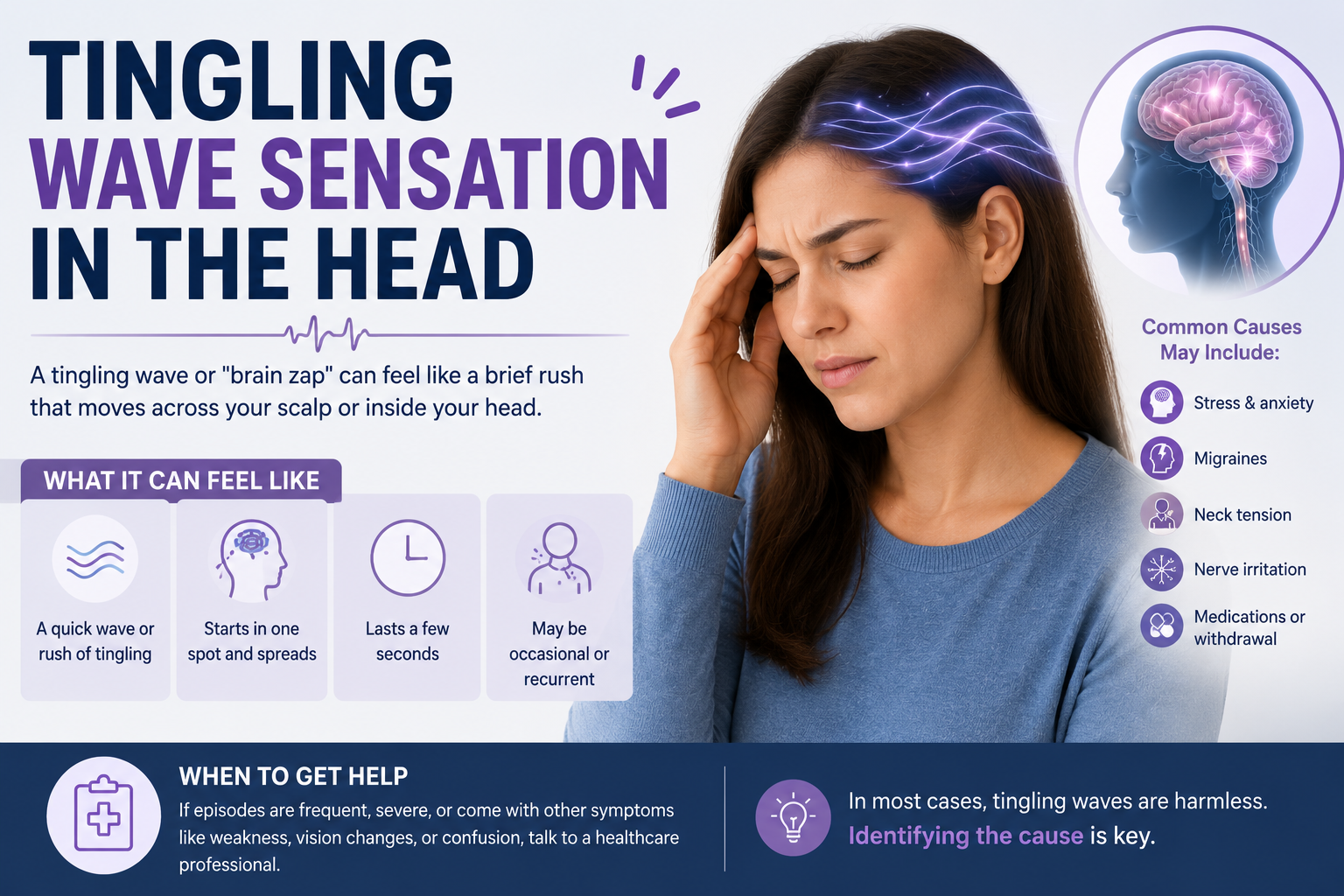
A pattern-based guide to scalp tingling, “brain zaps,” migraine aura, nerve symptoms, and urgent warning signs in 2026.
A tingling wave sensation in the head can feel like a ripple, buzzing current, brief electric jolt, crawling feeling, or pins-and-needles sensation moving across the scalp or face. The description is unsettling because it seems to come from inside the head, but the sensation often begins in the skin, sensory nerves, neck, or nervous system pathways rather than in the brain tissue itself.
One episode after poor sleep, an awkward neck position, intense stress, or a migraine may be temporary. Repeated episodes, symptoms that last for hours or days, or tingling accompanied by weakness, speech trouble, vision changes, confusion, or a sudden severe headache need a different level of attention. The safest way to think about this symptom is to study its timing, location, triggers, and accompanying signs before jumping to a diagnosis.
| KEY TAKEAWAYS
· A wave-like tingling feeling is a symptom, not a diagnosis. Common explanations include nerve irritation, migraine aura, stress-related overbreathing, medication changes, and temporary pressure on nerves. · A brief sensation by itself does not mean multiple sclerosis. MS is considered when tingling is persistent or recurrent and appears with other neurologic findings. · Sudden one-sided numbness or weakness, facial droop, speech difficulty, vision loss, severe imbalance, or a sudden intense headache requires an immediate 911 call. · A symptom diary can help a clinician distinguish a seconds-long electric jolt from migraine aura, a focal seizure, nerve pain, or a metabolic problem. · Do not stop prescription medication or start high-dose vitamins based only on tingling. Treatment depends on identifying the cause. |
Start With the Pattern, Not the Diagnosis
Two people may use the same phrase, “a wave through my head,” while describing completely different events. One may feel a two-second shock after missing doses of an antidepressant. Another may notice tingling that gradually travels from the hand to the face before a migraine. A third may have numbness that stays on one side and arrives with weakness. The description matters, but the pattern matters more.
What Does the Timing Suggest?
| Pattern | Possible Clues | Best Next Step |
| Seconds, after turning the neck or waking up | Pressure or irritation involving scalp or upper-neck nerves | Change position, note recurrence, and arrange care if it persists or causes pain |
| 5 to 60 minutes, gradually spreading | Sensory migraine aura, especially with visual changes, nausea, or light sensitivity | Discuss new or changing aura with a clinician; urgent care if symptoms are abrupt or unlike prior attacks |
| Brief, repetitive electric “zaps” | Medication dose changes, missed doses, sleep deprivation, or a stereotyped sensory event | Review medications and timing with the prescriber; do not stop medicine abruptly |
| Hours to days, or repeatedly in the same area | Inflamed or compressed nerve, shingles, migraine-related sensitivity, or another neurologic condition | Schedule a medical evaluation, especially if the symptom is new or worsening |
| Sudden, one-sided, with weakness or speech trouble | Stroke or transient ischemic attack must be ruled out | Call 911 immediately, even if the symptoms begin to improve |
What Is This Sensation, Medically Speaking?
Tingling, prickling, buzzing, burning, crawling, and electric sensations are forms of paresthesia. Paresthesia happens when sensory signals are altered somewhere along the pathway from the skin and peripheral nerves to the spinal cord and brain. The scalp and face contain many sensory nerve branches, so irritation can feel localized, moving, or wave-like even when the skin looks normal.
The MedlinePlus overview of numbness and tingling notes that abnormal sensations can have many causes, including nerve pressure or injury, migraine, vitamin deficiencies, medication effects, diabetes, multiple sclerosis, seizures, stroke, and transient ischemic attack. That broad list is why the symptom should be interpreted in context rather than matched to one condition from an online search.
Which Causes Fit a Wave-Like Head Sensation?
1. Temporary Scalp or Neck Nerve Irritation
The nerves supplying the back and top of the scalp pass through muscles and tissues in the upper neck. Sleeping with the neck twisted, leaning against a hard headrest, sustained screen posture, a tight hat, or muscle tension can irritate these nerves. The result may be a short ripple, prickling patch, or electric sensation that changes when the head or neck moves.
Occipital neuralgia is a more painful form of nerve irritation that often produces stabbing, shooting, or shock-like pain from the upper neck toward the scalp. It is usually more painful than a vague tingle and may make the scalp tender. A clinician can determine whether the symptom is coming from the neck, scalp nerves, a headache disorder, or another source.
2. Migraine Aura or Migraine-Related Sensory Changes
Migraine can affect sensory processing before, during, or after head pain. A sensory aura usually develops gradually over several minutes and may travel from one area to another. Some people feel tingling in the hand, lips, face, or scalp. Others describe a spreading current or wave. Visual zigzags, blind spots, difficulty finding words, nausea, light sensitivity, or a familiar migraine headache may occur at the same time.
A typical aura often lasts between 5 and 60 minutes, but a first-ever neurologic symptom should not be self-labeled as migraine. Sudden symptoms that reach full intensity immediately, especially with weakness or speech difficulty, require urgent evaluation because stroke and migraine can overlap in appearance.
3. Stress, Panic, and Overbreathing
Stress can tighten scalp and neck muscles, disrupt sleep, increase migraine susceptibility, and change breathing. During panic or rapid breathing, carbon dioxide levels can fall, which may trigger tingling around the mouth, face, hands, or scalp, along with lightheadedness and chest tightness. The sensation is real even when anxiety is the trigger.
Anxiety should be considered after urgent and medical causes are addressed, not used as an automatic explanation. Recurrent episodes can still benefit from a primary care assessment, particularly if they are new, occur without obvious stress, or include fainting, weakness, or prolonged confusion.
4. Medication Changes and “Brain Zaps”
Some people describe brief electric shock-like feelings in the head after missing doses, reducing the dose, or stopping certain antidepressants and other nervous-system medications. These sensations are often called brain zaps. They may be accompanied by dizziness, vivid dreams, nausea, imbalance, irritability, or flu-like symptoms.
Do not abruptly stop or restart a prescription drug to test whether it is responsible. Contact the prescriber or pharmacist and provide the exact medication name, dose, last dose taken, and timing of the symptoms. A supervised taper may be needed when discontinuing certain medicines.
5. Blood Sugar, Vitamin, Thyroid, or Electrolyte Problems
Low blood sugar can cause tingling around the lips or face along with sweating, shakiness, hunger, palpitations, or confusion, particularly in people using insulin or certain diabetes medications. Vitamin B12 deficiency, thyroid disorders, and abnormal calcium or other electrolyte levels can also alter nerve function. These problems usually cause additional symptoms and are evaluated with history, examination, and targeted blood tests.
Avoid taking high-dose B vitamins without testing or medical advice. Too much vitamin B6, for example, can itself damage nerves. A clinician can decide whether a complete blood count, glucose testing, thyroid studies, electrolytes, or vitamin levels are appropriate.
6. Shingles, Skin Inflammation, or Facial Nerve Conditions
Shingles can begin with tingling, burning, sensitivity, or pain on one side of the scalp or face before a blistering rash appears. A rash near the eye or on the forehead needs same-day medical attention because eye complications are possible. Dental inflammation, sinus-related pressure, skin irritation, and trigeminal nerve disorders can also create abnormal facial or scalp sensations, although their patterns differ.
7. Focal Sensory Seizures
A focal aware seizure can cause a brief, highly similar sensation each time it occurs. The event may include tingling, an electric feeling, an unusual smell or taste, a rising sensation in the stomach, visual changes, déjà vu, or involuntary movement. These episodes are commonly brief and stereotyped. Repeated identical spells, especially with altered awareness, memory gaps, or jerking, should be discussed promptly with a clinician or neurologist.
Does Tingling in the Head Mean Multiple Sclerosis?
Usually, head tingling alone is not enough to suggest multiple sclerosis. MS can cause numbness, tingling, pain, vision problems, weakness, balance difficulty, bladder symptoms, and other neurologic changes because it affects the brain, optic nerves, and spinal cord. The location and combination of symptoms depend on which nervous-system pathways are affected.
The National Institute of Neurological Disorders and Stroke lists tingling or numbness among possible MS symptoms, but diagnosis requires much more than one sensation. Clinicians look for a neurologic history and examination consistent with lesions occurring in different parts of the central nervous system and at different times. MRI findings and, in selected cases, spinal fluid or other tests help support the diagnosis and rule out mimics.
Features that make a neurologic evaluation more important include tingling that lasts more than a day, repeated episodes with no clear trigger, loss of vision or pain with eye movement, persistent weakness, coordination problems, bladder changes, or numbness involving a larger body region. Even then, MS is only one of several possibilities.
When Is a Tingling Wave a Stroke Warning?
A mild isolated scalp tingle is not a typical stroke presentation, but sudden numbness or altered sensation can be part of a stroke or transient ischemic attack when it affects one side of the face or body and appears with other neurologic signs. Do not wait to see whether symptoms pass.
According to the CDC stroke warning signs, call 911 for sudden one-sided numbness or weakness, confusion, trouble speaking, vision changes, trouble walking, loss of balance, or a sudden severe headache with no known cause. If symptoms disappear after a few minutes, a transient ischemic attack is still a medical emergency and can warn of a future stroke.
| CALL 911 NOW IF THE TINGLING IS ACCOMPANIED BY:
· Facial droop, arm or leg weakness, or numbness on one side · Slurred speech, trouble understanding words, or sudden confusion · Sudden vision loss, double vision, severe imbalance, or inability to walk normally · A sudden “worst headache,” loss of consciousness, or a seizure lasting five minutes or longer · Symptoms immediately after a significant head, neck, or back injury |
How Will a Clinician Investigate the Symptom?
The evaluation usually begins with a detailed timeline and neurologic examination. The clinician may check facial movement, sensation, strength, reflexes, balance, coordination, eye movements, speech, and neck tenderness. Testing is based on what the history and examination suggest, not on the symptom phrase alone.
Questions That Help Narrow the Cause
- Did the sensation begin suddenly or build gradually?
- How long does each wave last, and does it travel in a consistent direction?
- Is it limited to the scalp, or does it involve the face, mouth, arm, or leg?
- Do visual changes, headache, nausea, light sensitivity, neck pain, rash, weakness, or confusion occur with it?
- Did it start after a medication change, missed dose, illness, injury, dental problem, poor sleep, or heavy caffeine use?
- Are the episodes identical each time, and is awareness affected?
Blood tests may be used to check glucose, electrolytes, thyroid function, blood counts, or vitamin levels. Brain or spine imaging may be appropriate when the examination suggests stroke, MS, a structural problem, or another central nervous-system cause. An EEG may be considered for recurrent stereotyped spells that could represent seizures. Many people with a brief, nonprogressive symptom and a normal examination do not need every test.
What Can You Do While Waiting for an Appointment?
For a mild symptom without emergency signs, create a short record instead of repeatedly checking the sensation. Note the date, start time, duration, exact location, direction of movement, recent sleep, meals, caffeine, stress, medications, headache symptoms, and anything that stopped the episode. A phone video may help if there is visible facial movement, eye twitching, or another physical sign.
- Keep regular meals and hydration, particularly if episodes occur when you have not eaten.
- Use a neutral neck position and take breaks from prolonged screen posture.
- Follow prescribed medication schedules and contact the prescriber about missed doses or recent dose changes.
- Avoid driving, climbing, swimming alone, or operating machinery if episodes cause altered awareness, severe dizziness, or vision changes.
- Arrange a primary care visit when symptoms recur, last longer, spread, or have no clear explanation.
Do not rely on repeated online symptom matching to rule out urgent problems. The same sensation can have different causes, and the presence or absence of weakness, speech changes, visual symptoms, rash, headache, medication changes, and a normal neurologic examination can substantially change the interpretation.
A Practical Bottom Line
A tingling wave sensation in the head is often related to temporary nerve irritation, migraine, stress-related breathing changes, sleep disruption, or medication effects. It can also occur with shingles, metabolic problems, seizures, MS, and other neurologic conditions. One isolated sensation cannot reliably identify the cause.
Treat sudden one-sided symptoms or any episode with weakness, speech difficulty, confusion, vision loss, severe imbalance, or a sudden intense headache as an emergency. For nonurgent but recurring symptoms, document the pattern and arrange a medical evaluation. The goal is not simply to stop the tingle, but to identify whether the nervous system is reacting to a temporary trigger or signaling a condition that needs treatment.
Medical note: This article is for general educational purposes and does not diagnose a medical condition or replace care from a licensed healthcare professional.